What gamification for business actually means
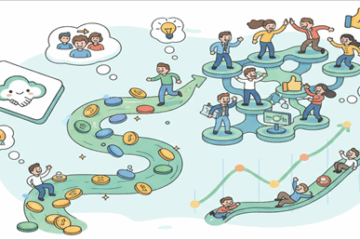
Gamification for business is the practice of applying game mechanics progress, feedback, challenge, and reward to real business moments: a first website visit, a checkout, an onboarding flow, a training module, a renewal decision. It isn’t about turning your product into a game. It’s about borrowing the small structural things that make games hard to put down and using them to get someone to finish a form, come back tomorrow, or try the feature they’ve been ignoring.
The businesses getting real value from it aren’t the ones handing out points and badges for their own sake. They’re the ones treating gamification as a lever on a specific number opt-in rate, time-to-first-value, day-30 retention and picking a mechanic that moves that number.
Why it works
Three things make gamification effective where a standard call-to-action isn’t:
- It asks for participation, not attention. A banner asks someone to notice it. A quiz, a spin, or a progress bar asks someone to do something and action changes how a person relates to a brand more than a glance does.
- It gives instant feedback. Most business processes make someone wait: submit a form, wait for a follow-up; sign up, wait for value. Game mechanics close that loop immediately, which is a big part of why they convert and retain better than static equivalents.
- It lowers the perceived cost of a decision. A quiz that takes fifteen seconds feels lower-stakes than a lead form with the same six questions, even though it’s collecting the same information.
The scale of adoption backs this up: businesses running gamified campaigns typically see engagement rates well over double what standard formats produce, gamified content gets shared at a far higher rate than static content, and the gamification platform market itself is on a trajectory to roughly triple in size over the next several years. This isn’t a novelty tactic anymore it’s becoming standard infrastructure across marketing, sales, HR, and product.
Where gamification for business actually gets applied
Gamification doesn’t necessarily mean creating a complete game. Businesses can use different game mechanics to encourage participation, interaction and desired actions.
| Gamification mechanic | How it works | Common business use |
|---|---|---|
| Quizzes | Users answer questions to get a result | Lead generation, qualification |
| Spin-to-win | Users spin a virtual wheel for an outcome | Promotions, engagement |
| Scratch cards | Users reveal a hidden result or reward | Lead capture, campaigns |
| Challenges | Users complete a task or objective | Engagement, training |
| Points | Users earn points for actions | Loyalty, motivation |
| Leaderboards | Users compete based on performance | Employee engagement, events |
| Badges | Users receive recognition for achievements | Training, onboarding |
| Progress bars | Users see how close they are to completion | Training, onboarding |
Popular Gamification Mechanics for Business
Gamification isn’t one thing bolted onto a website it shows up differently depending on which part of the business it’s solving for.
Marketing & lead generation. Spin-the-wheel offers, scratch cards, and preference quizzes turn a cold visitor into an opted-in contact before they’ve seen a sales pitch. This is usually the highest-ROI, fastest-to-launch entry point for a business trying gamification for the first time.
Customer engagement & loyalty. Streaks, tiered rewards, and visible progress toward a goal keep an existing customer coming back the difference between a loyalty program that feels alive and a points balance nobody checks.
Onboarding & product adoption. Progress trackers and unlockable steps shorten the gap between signup and first real value, which is the single biggest lever against early churn in any subscription or app-based product.
Sales & lead qualification. A “which option fits you” style quiz does double duty it feels useful to the person answering, and it hands the sales team pre-qualified intent data instead of a blank contact form.
Training & internal engagement. Lesson streaks, scored simulations, and completion badges turn compliance-heavy training into something people actually finish, and give HR a built-in completion metric instead of chasing sign-offs.
Each of these plays out differently depending on the industry retail leans hardest on discovery-stage mechanics like wheels and scratch cards, while SaaS and education lean hardest on progress and streaks. Covering everything from BFSI and real estate to hospitality and eCommerce.
The mistake most businesses make with gamification
Decorative gamification fails. A points system with no meaningful reward, a badge nobody asked for, or a game slapped onto a page with no connection to what the user actually wants produces a short novelty bump and nothing durable.
The businesses seeing multi-year results treat the game layer as behavior design tied to one specific outcome, and they match the type of mechanic to the moment in the customer relationship an instant-win format at a single transaction point like checkout, a streak or progress bar when the goal is building a repeated habit like daily logins or course completion. Getting that match wrong is the most common reason a gamification campaign underperforms, more common than a weak prize or bad design.
Getting started without an engineering backlog
The gap between “we should gamify our onboarding” and an actual shipped experience is usually a development queue, not a lack of ideas. That’s the specific problem no-code gamification platforms exist to close spin-the-wheel, scratch card, swipe games, quizzes, and match-style mechanics that a marketing or ops team can build, brand, and launch without waiting on engineering.
Playly is built for exactly this: pick a mechanic, customize it to your brand, connect it to your lead capture or CRM, and publish no developer required at any step.
Build your first gamified campaign
Frequently Asked Questions About Gamification for Business
It’s applying game-like elements progress, rewards, feedback, competition to a normal business process, so that process gets more participation than it would as a plain form, page, or message.
It works when it’s tied to a real decision point in the customer journey a checkout, a signup, a renewal. It fails when it’s decorative: points or badges with no real reward or connection to what the user wants.
Costs vary widely by approach. Custom-built game mechanics require developer time and ongoing maintenance; no-code platforms let a marketing team launch a gamified campaign for a fraction of that cost and in a fraction of the time, since no engineering resource is needed.
No, no-code platforms like Playly let you build and embed gamified experiences (spin-the-wheel, quizzes, scratch cards) using a visual builder and pre-built templates, with no code involved at any step.
Marketing and lead generation is usually the fastest, lowest-risk starting point a single spin-the-wheel or quiz campaign can launch in days and shows results immediately, unlike onboarding or retention mechanics, which take longer to prove out.
No. B2B and internal use cases, sales lead qualification, employee onboarding, training completion use the same mechanics, just applied to a longer, more considered decision instead of a single purchase.
.
More ideas. Less noise.
Get ideas with actual impact from Playly.ai
3 Comments
Gamification for Employee Engagement: 7 HR Strategies · September 15, 2026 at 12:34 pm
[…] Gamification for Business: The Complete Guide to Turning Engagement Into Revenue […]
15 Best Gamification Platforms for Customer Engagement · September 30, 2026 at 9:56 am
[…] Gamification for Business: The Complete Guide to Turning Engagement Into Revenue […]
How to Collect Zero-Party Data with Gamification (GDPR-Safe) · October 9, 2026 at 12:12 pm
[…] tricky part is getting people to share it willingly. That’s where gamification comes in. In this guide, we’ll walk through how to collect zero-party data with gamification, […]