In the digital landscape of 2026, the “static ad” is officially on life support. With average attention spans hovering around three seconds, the traditional marketing funnel is broken. You can have the world’s most innovative product, but if your customers are mindlessly scrolling past your promotions, your ROI is going to feel the pinch.
If you want to understand how gamification turns engagement into real conversions, our breakdown of use cases across industries is a good starting point then come back here to see how Catch the Product fits in.
In this high-stakes battle for consumer attention, it is the Experience that determines the victor. Consumers no longer want to be sold to; they want to be entertained, challenged, and rewarded. If you are still relying on static banners or “10% off” pop-ups that users close before the page even finishes loading, you are leaving money on the table.
It’s time to flip the script. Enter “Catch the Product,” the high-performance gamification tool from Playly.ai that is transforming passive viewers into active brand participants.
What Exactly is “Catch the Product”?
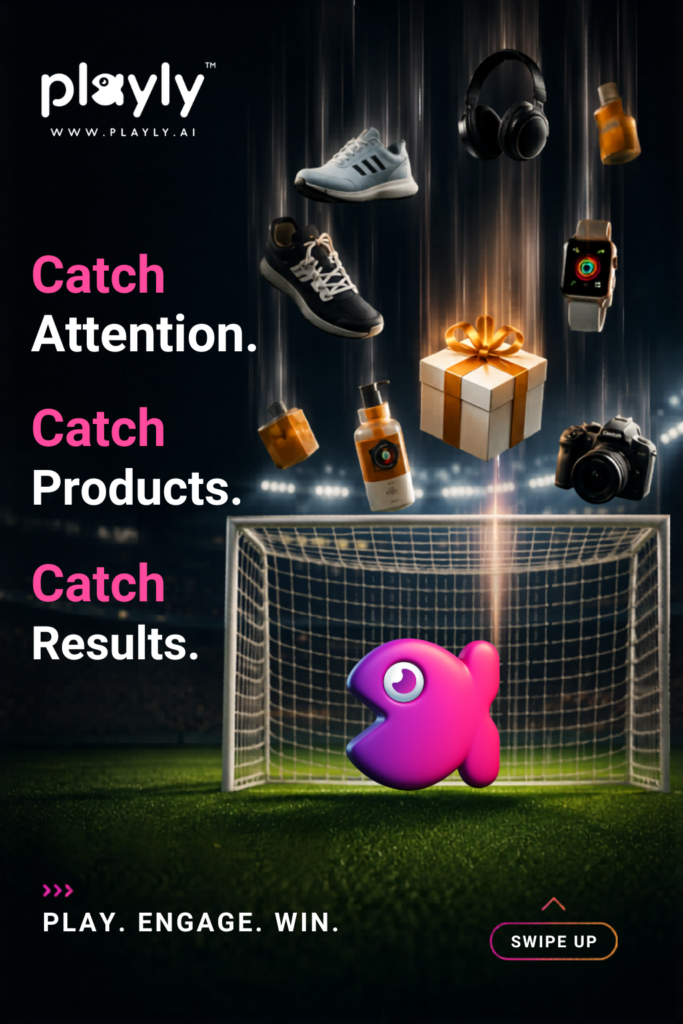
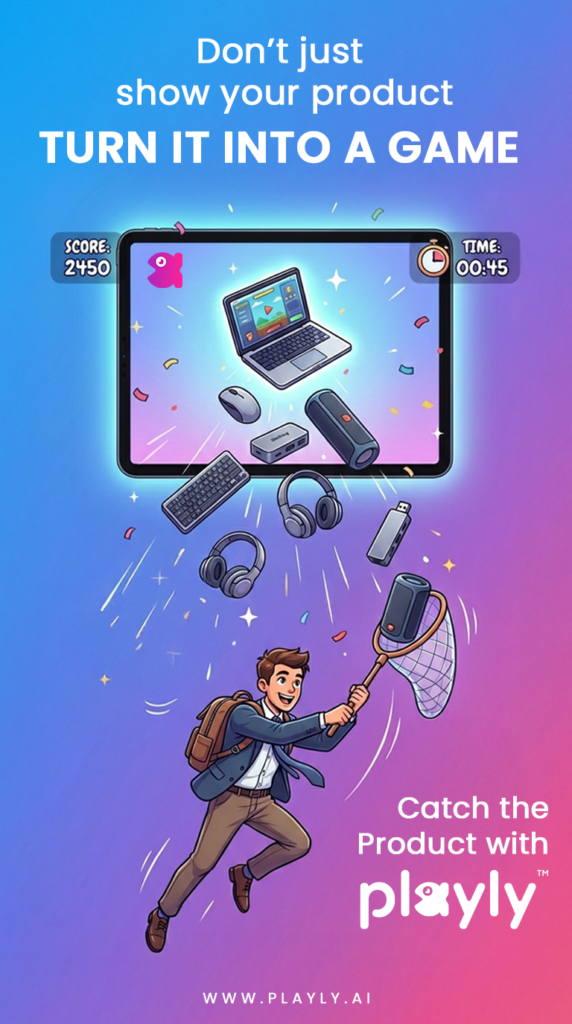
At its core, Catch the Product is a fast-paced, arcade-style web game built for the modern browser. The mechanics are elegantly intuitive: objects fall from the top of the screen, and the player moves a container be it a shopping bag, a gift box, or even a branded character at the bottom to catch them.
While it sounds simple, the marketing psychology behind it is profound. By transforming your physical inventory into falling “game pieces,” you are forcing the consumer to visually identify, track, and “grab” your products. This creates a level of cognitive brand recall that traditional display advertising simply cannot match. You aren’t just showing them a shoe; you’re making them “catch” the shoe to win.
Why It Works: The Psychology of Play
Why does a 30-second game consistently outperform a professionally designed static ad? It comes down to three psychological pillars:
- The Flow State : When a user starts playing, they enter “the flow” a state of intense focus where the outside world fades away. During these 30 to 60 seconds, your brand has their undivided attention. They aren’t looking at their notifications or clicking away to another tab; they are locked into your brand universe.
- Earned Value Perception : Psychologically, we value things more when we work for them, a phenomenon known as the IKEA effect. A coupon code handed out for free feels like “spam.” However, a coupon code “unlocked” after scoring 800 points feels like a trophy. Users are significantly more likely to complete a purchase using a reward they feel they’ve earned through skill.
3. The Dopamine Loop : The “Catch” mechanic provides instant gratification. Every time a player catches a product, they hear a satisfying “ding” and see their score rise. This creates a positive neurological association with your brand images. By the time the game ends, the user is in a “Yes” mindset, making them much more receptive to your Call-to-Action (CTA).
Catch the Product in action
Creative Use Cases: How Brands are Winning
To help you visualize the versatility of Catch the Product, let’s look at how different industries can deploy this game on Playly.ai:
E-Commerce: The “Mystery Box” Launch
Imagine a fashion brand launching a new summer collection. Instead of a standard lookbook, they launch a “Catch the Summer” game. Users catch sunglasses, sun hats, and sandals. To add difficulty, they must avoid “rain clouds” that deduct points.
- The Hook: Anyone who scores over 1,000 points gets an early-access link to the collection 24 hours before the general public, turning shoppers into “VIP winners.”
Food & Beverage: The “Build Your Burger” Challenge
A Quick Service Restaurant (QSR) chain wants to promote a new premium burger. In the game, players have to catch specific ingredients like lettuce, tomato, the special patty in a specific order to get “Combo Points.”
- The Hook: The top 50 players on the weekly leaderboard win a physical voucher for a free meal, while everyone else gets a “Buy One Get One” (BOGO) code sent straight to their email.
Beauty & Skincare: The “Routine Grab”
A skincare brand uses the game to educate users on a complex 3-step routine. Players must catch the Cleanser, Toner, and Serum while avoiding “Dirt” and “Pollution” icons.
- The Hook: The “Game Over” screen features a personalized CTA: “You caught the Glow Serum! Click here to see why it’s our #1 bestseller and get it for 15% off.”
For skincare and wellness brands looking to educate while they sell, word puzzle gamification is another strong format it gets users to actively search for your product name rather than passively scroll past it.
Travel & Tourism: “Catch the Destination”
A travel agency drops icons representing different vacation vibes Eiffel Towers for city breaks, Palm Trees for tropics, and Skis for winter sports.
- The Hook: Depending on which category of items the player catches most, the final screen says, “It looks like you’re a Beach Lover! Here is $50 off your next tropical booking.” This is data-driven marketing disguised as fun. Want to take audience profiling even further? Pair this with a This or That game to collect preference data before the campaign even starts.
Best Practices for Your Playly.ai Campaign
To get the most out of your Catch the Product game, keep these “Pro-Tips” in mind:
- Quality Assets Matter: Use high-resolution, transparent PNGs. If the items look delicious or stylish as they fall, the desire to own them increases.
- Keep it Short: The sweet spot is 30 to 45 seconds. You want to leave them with a “high” from winning, not fatigue from playing.
- The “Lead Gate” Strategy: Never ask for an email before the game. Let them play first! Once they see their high score, they will be much more willing to enter their details to “save” their spot on the leaderboard or claim their prize. This same play-first, capture-later logic is what makes spin-the-wheel lead generation one of Playly.ai’s highest-converting formats the reward feels earned, not given.
- Mobile-First Design: Ensure the game is mobile-first design. Playly.ai handles the technical responsiveness but always test the “feel” on a mobile device to ensure the speed is challenging but fair.
Ready to build your campaign?
Measuring Success: Beyond the High Score
When you run a Catch the Product campaign, you aren’t just looking at “games played.” Playly.ai provides deep analytics that help you measure:
- Engagement Time: How long did the average user spend interacting with your products?
- Conversion Rate: What percentage of players clicked through to the shop after the game?
- Viral Coefficient: How many users shared their high score on social media, bringing in free organic traffic?
From Boredom to Boardrooms
The digital space is crowded, and “ad fatigue” is a real threat to your bottom line. To cut through the noise in 2026, you need to offer value before you ask for a sale. Catch the Product provides that value through pure, unadulterated entertainment.
By integrating this game into your marketing strategy via Playly.ai, you aren’t just selling a product you’re starting a conversation. You’re inviting your customer to play, to compete, and ultimately, to join your brand community.
Are you ready to turn your product catalog into a playground? Start building your “Catch the Product” campaign today and watch your engagement metrics reach a new high score.
Want a custom gamified campaign for your brand?
Q&A
Switch from passive ads to active play. Gamification tools like “Catch the Product” create “Earned Value” customers are far more likely to use a discount they “won” in a game than a coupon they were just handed.
The trend has moved from boring wheels to skill-based games. Playly.ai is the leader here, offering no-code, arcade-style experiences (like “Catch the Product”) that use your actual product images as game assets.
Use Micro-Engagement. A 30-second “Catch the Product” game hooks users into a “Flow State,” making them 80% less likely to leave the page before seeing your offer.
Use a “Lead Gate” at the end of a game. Instead of interrupting the user, you invite them to enter their email to save their high score or claim their prize. It turns a “chore” into a “reward.”
Don’t just post a photo; let customers “catch” your new line. A “Catch the Product” game forces users to visually track and interact with your new inventory for 30+ seconds, creating instant brand recall.
More ideas. Less noise.
Get ideas with actual impact from Playly.ai
1 Comment
How to Collect Zero-Party Data with Gamification (GDPR-Safe) · October 9, 2026 at 12:12 pm
[…] Memory Game, Catch the Product […]