Brands exploring new approaches have started looking at something different.
Every March, something interesting tends to happen to marketing conversations across India. Budgets shift, campaigns accelerate, and brands start looking for ways to connect with audiences around one of the country’s most talked-about sporting events, the IPL.
The Indian Premier League is more than just a cricket tournament. For several weeks, it becomes a shared national moment where millions of people follow matches, discuss performances, and engage with cricket content across multiple platforms.
Brands that manage to participate meaningfully during this time often gain more than visibility. They become part of the conversation that fans are already having.
Want to launch an IPL campaign for your brand this season?
However, many brands still approach IPL marketing with a traditional mindset. The focus often stays on visibility, logo placements, advertising slots, or sponsored content. While those strategies can create awareness, they may not always lead to deeper engagement.
They recognize that today’s IPL audience rarely watches the match in isolation. Fans often have their phones in hand, discussing plays on messaging apps, sharing reactions on social media, checking stats, or following fantasy leagues.
In many ways, fans are not just watching the game anymore. They are interacting with it.
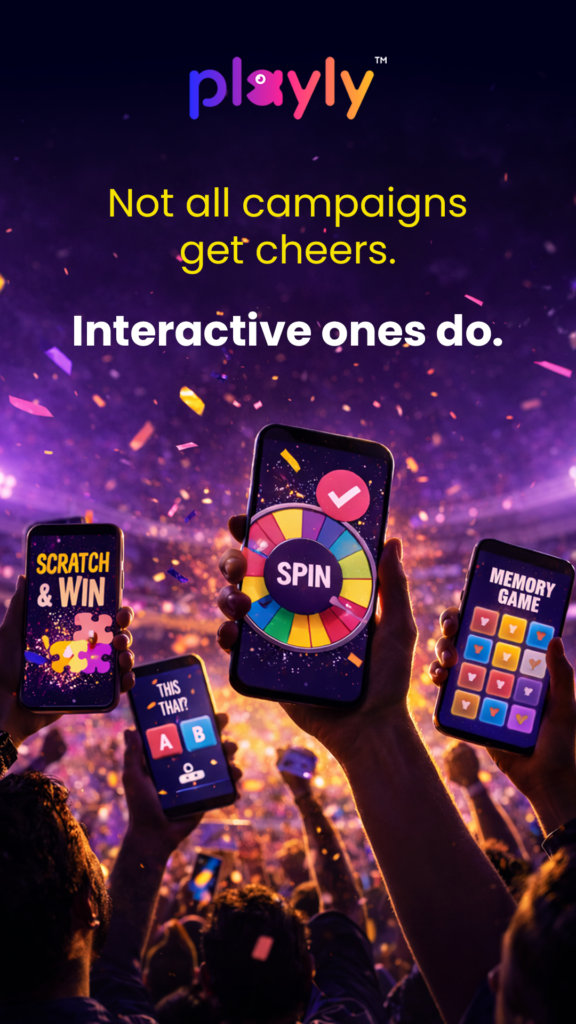
This is where gamification can potentially play a role and where platforms like Playly.ai aim to help brands create more interactive campaign experiences.
Why IPL Can Be a Strong Moment for Gamification Marketing
During an IPL match, fan behaviour tends to be dynamic and multi-screen.
A viewer may be watching the game on television while simultaneously scrolling through social media, discussing moments with friends, or checking match predictions online. Attention moves between platforms, but emotional involvement with the match remains high.
From a marketing perspective, this environment can make purely static advertising less noticeable. Interactive experiences, however, may fit more naturally into what fans are already doing online.
For example, a brand inviting fans to predict the match outcome, spin a wheel for match-day offers, or answer cricket trivia is participating in the fan conversation rather than interrupting it.
Many marketers see gamification as a way to extend the match-day experience rather than compete with it.
7 IPL Gamification Campaigns You Can Build during this IPL
Playly.ai offers several interactive formats that can align with different moments throughout the IPL season, from pre-season buzz to match-day engagement and post-purchase interaction.
Below are a few campaign ideas brands might consider experimenting with.
Campaign 01: IPL Match Prediction Campaign: Spin Wheel Gamification for Fans
Match Prediction Spin Wheel: A branded wheel fans spin before each match to predict outcomes, earning rewards for correct guesses.
Brands can invite fans to spin a branded wheel before each match and make light-hearted predictions such as the toss winner, top scorer, or number of sixes.
Participants might receive a personalised result immediately, while correct predictions could unlock small rewards or offers after the match.
This type of campaign can run throughout the season, giving fans multiple opportunities to interact with the brand. Some brands also choose to gate the experience behind an email submission to capture leads.
Follow-up emails referencing the match prediction may also help keep fans engaged after the game concludes.
Importantly, this style of campaign can work without official IPL sponsorship since it focuses on the fan experience around cricket rather than league trademarks.
Launch your own Match Prediction Wheel in under 10 Mins.
Campaign 02: The IPL Cricket IQ Quiz
Cricket IQ Quiz (Interactive Quiz): A short trivia quiz testing fans on IPL history and player stats, rewarding top scorers with brand offers or prize entries.
Cricket quizzes are a natural fit during IPL season. Brands can build short quizzes around IPL history, team trivia, player statistics, or general cricket knowledge.
Users might be asked to submit their email before viewing results, allowing brands to capture leads while providing an entertaining experience.
Quiz campaigns often encourage friendly competition among fans. Participants sometimes share their scores with friends, which may expand reach organically.
Brands may also update quiz questions periodically based on recent matches, giving audiences a reason to revisit the experience.
Campaign 03: The Match-Day Scratch Card
Match-Day Scratch Card: A digital scratch card fans reveal on match days to instantly uncover discounts, freebies, or prize draw entries.
Another interactive option is a digital scratch card available on match days. Fans can scratch a virtual card to reveal a reward such as a small discount, free delivery offer, loyalty points, or entry into a larger prize draw.
The simple act of revealing a hidden reward can create curiosity and anticipation. Because the outcome is unknown until the moment of interaction, it can encourage participation.
Some brands also introduce limited-time variations during the later stages of the tournament, increasing excitement as the season progresses.
Offering a mix of common rewards and occasional premium prizes can help maintain interest while keeping costs manageable.
Campaign 04: The Team Loyalty Personality Quiz
Team Loyalty Personality Quiz: A fun personality quiz that matches fans to a cricket identity or captain style, delivering shareable results they can post on social media.
Personality quizzes can be particularly engaging during sports seasons.
A quiz such as “What type of IPL fan are you?” or “Which IPL captain’s leadership style matches yours?” allows fans to receive a personalised result that reflects their cricket identity.
The results can be presented as shareable cards, which participants may choose to post on social media.
These quizzes can also collect valuable zero-party data such as team preferences, fan behaviour, or viewing habits. That information can later support more personalised marketing campaigns.
Campaign 05: The Six-Hit Slot Machine
Six-Hit Slot Machine: A real-time instant-win game triggered during live match moments like a six, inviting fans to spin and grab a reward while the excitement is fresh.
Some brands experiment with real-time marketing during matches. For instance, when an exciting moment occurs, such as a six being hit, the brand might invite fans to spin a slot machine or play a quick instant-win game.
Notifications through email, social media, or messaging channels can prompt fans to participate while the match excitement is still fresh.
Because these campaigns align with live match moments, they can sometimes feel more relevant and timely for fans following the game closely.
This format may be particularly suitable for brands associated with match-day consumption, such as snacks, beverages, or food delivery.
Not sure which campaign fits your brand?
Campaign 06: The IPL Season Advent Calendar
IPL Season Advent Calendar: A daily campaign hub where fans return each day to unlock new games, offers, or content, building loyalty across the entire IPL season.
Another approach is to treat the entire IPL season as a daily engagement journey.
Brands can create a campaign page where a new game, offer, or piece of content unlocks each day. Fans who return regularly can accumulate points toward larger rewards.
This structure may encourage repeated interaction with the brand rather than a single campaign touchpoint.
It can also mirror the progression of the IPL season itself building anticipation as the tournament moves toward its final stages.
IPL 2026 is live right now. Every match day without a campaign is a missed opportunity.
Campaign 07: The eCommerce Flash Game
eCommerce Flash Game: A post-purchase spin wheel that rewards customers right after they buy, offering discounts or loyalty points to bring them back for their next order.
For eCommerce brands, the post-purchase moment can sometimes be a good opportunity to introduce a gamified experience.
After completing a purchase, customers might be invited to spin a reward wheel offering discounts, loyalty points, or offers on their next order.
Because the purchase has already been completed, customers may feel more relaxed and open to engaging with a brand interaction.
Some brands also connect offline and online experiences by adding QR codes to product packaging that link to a seasonal game or campaign page.
Gamification vs Traditional IPL Advertising
Still wondering if gamification is worth it over traditional IPL advertising? Here’s a quick comparison:
| Factor | Traditional IPL Ads | Gamification |
| Cost | High | Low to Medium |
| Sponsorship | Often Yes | No |
| Fan Interaction | Passive | Active |
| Lead Capturing | Low | High |
| Data Collected | Minimal | Rich |
| Share ability | Low | High |
| Works for Small brands | Low | High |
| Setup Time | 1 to 2 days | 15 Mins |
| Campaign Control | Low | Full |
See why 500+ brands choose gamification over traditional IPL ads.
Evaluating the Performance of Your IPL Gamification Campaign
Since IPL marketing campaigns run for a defined period, many brands pay close attention to performance metrics during and after the season.
One useful metric is game completion rate, which indicates how many users start and finish the interactive experience. This can provide insight into whether the format feels engaging and easy to participate in.
Another common metric is email opt-in behaviour, which helps marketers understand whether the campaign is effectively converting interactions into leads for future communication.
Brands may also look at social sharing activity, particularly for quizzes and personality games where users might post results publicly. These shares can sometimes extend campaign reach beyond the original audience.
For longer campaigns, repeat participation can offer insight into whether users are returning to engage with the experience multiple times. Finally, marketers often compare cost per lead and downstream revenue impact with their usual campaign benchmarks to understand whether seasonal marketing efforts contributed to overall marketing goals.
Want to track all these metrics in one dashboard?
The Final Over (IPL Marketing Strategy: What Brands Should Focus On)
IPL season represents a unique cultural moment in India’s marketing calendar. For several weeks, cricket becomes a major part of daily conversation across media platforms.
Some brands focus primarily on visibility during this time. Others explore ways to participate more interactively with fans.
Gamification offers one possible approach to doing that. Interactive experiences such as quizzes, prediction games, and scratch cards can give audiences something to engage with while they are already immersed in the cricket conversation.
The campaigns discussed in this guide illustrate how brands might experiment with different engagement formats during the season.
Today, platforms like Playly.ai aim to make these experiences easier to design and launch without heavy development work.
With the IPL season approaching, many brands may start asking themselves a simple question:
What role will our brand play in the conversation this year?
FAQs
Brands may create interactive experiences such as prediction games, quizzes, scratch cards, or personality tests that connect with cricket conversations during the season.
Platforms like Playly.ai provide tools to build interactive campaigns such as spin wheels, quizzes, and instant-win games without requiring complex development.
Costs typically depend on the platform used, the scale of promotion, and the type of rewards offered in the campaign.
Brands often experiment with rewards such as discount codes, free shipping offers, merchandise, loyalty points, or limited-time promotions.
Some brands begin their campaigns before the tournament starts to build early awareness, while others focus on match-day engagement during the season.
More ideas. Less noise.
Get ideas with actual impact from Playly.ai
0 Comments